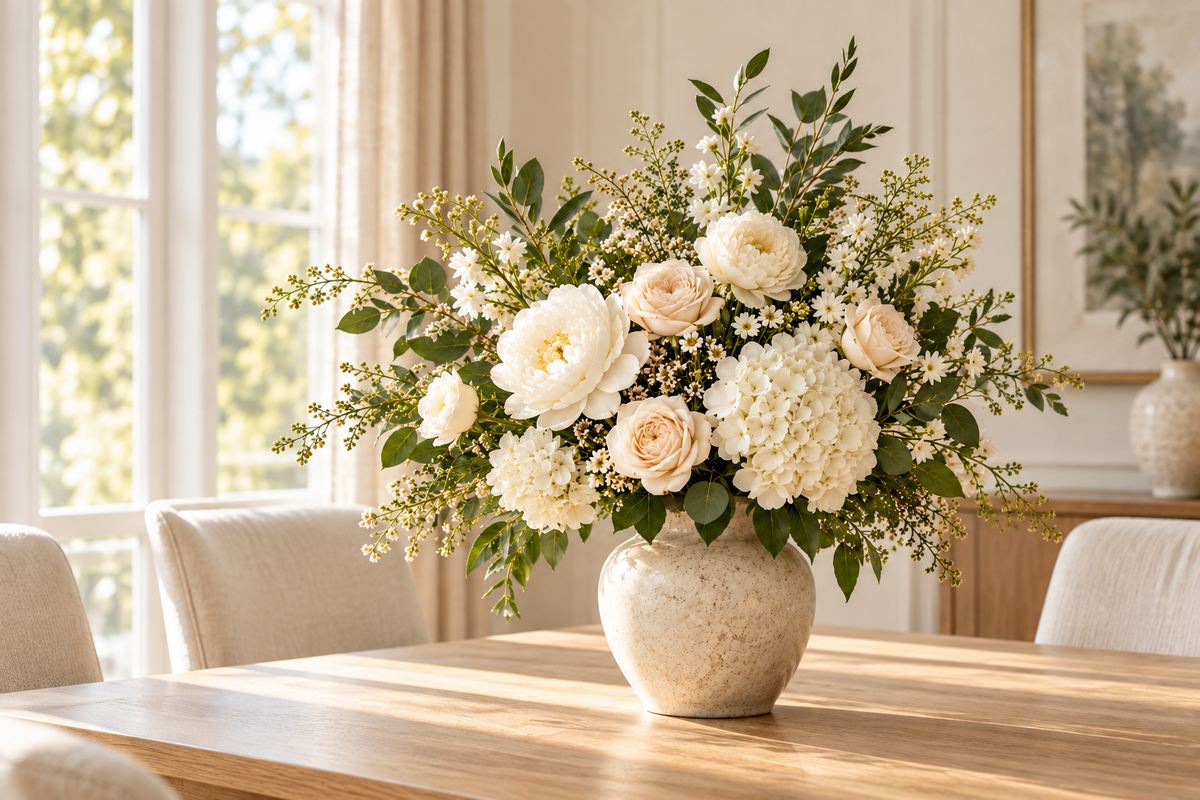
Realistic artificial flowers need to work at two distances: as part of a room and close enough to see the petals. A convincing arrangement combines believable flower shapes, subtle colour and stems that sit naturally in a vase. A material label alone cannot tell you whether it will achieve that.
What makes faux flowers look real?
Start with the outline. Natural flowers rarely form a row of identical circles at exactly the same height. Look for gentle differences in opening, angle and scale. Then examine the details: petal edges, the transition into the centre, the underside of the bloom and the point where the flower meets the stem.
- Colour: look for soft tonal changes instead of a single flat colour across every petal.
- Surface: check the finish in ordinary daylight. A very glossy leaf or thick seam can stand out even when the flower head is attractive.
- Construction: inspect visible glue, exposed wire, repeated mould marks and loose joins.
- Foliage: leaves should suit the scale and character of the flower, with plausible veins and stems.
- Movement: positionable stems help you create a relaxed outline; avoid forcing delicate joins.
Real touch, silk or another material?
These terms describe different things, and retailers do not always use them consistently. “Silk flowers” may be a general name for artificial flowers rather than a statement that the petals contain silk. “Real touch” usually describes the intended feel. Ask for the actual material if composition matters to you, and compare photographs of the whole stem as well as close-ups. Our real touch and silk flower guide explains what to check.
Choose flowers for the place they will live
A dining table needs a different silhouette from an entrance hall. Measure the available height and width, including nearby lamps, shelving and the space people use. Check whether the listed dimensions cover the flowers alone or the arrangement in its vase. Confirm whether the vase is included before comparing prices.
For a calm, full arrangement, start with artificial hydrangeas. For layered focal flowers, read our artificial peony guide. Mixing a small number of flower shapes with foliage often feels more coherent than combining many unrelated varieties.
How to assess an online listing
Look for photographs of the actual item from several angles, clear dimensions, material details, what is included and care instructions. Styled imagery helps you imagine a room, but physical product photography is what lets you assess a purchase. Price does not establish quality by itself.
The Everanthe approach
Explore Everanthe’s signature arrangements by palette and silhouette. Start with the size guide, compare materials and use our styling guide to plan a display that feels at home.