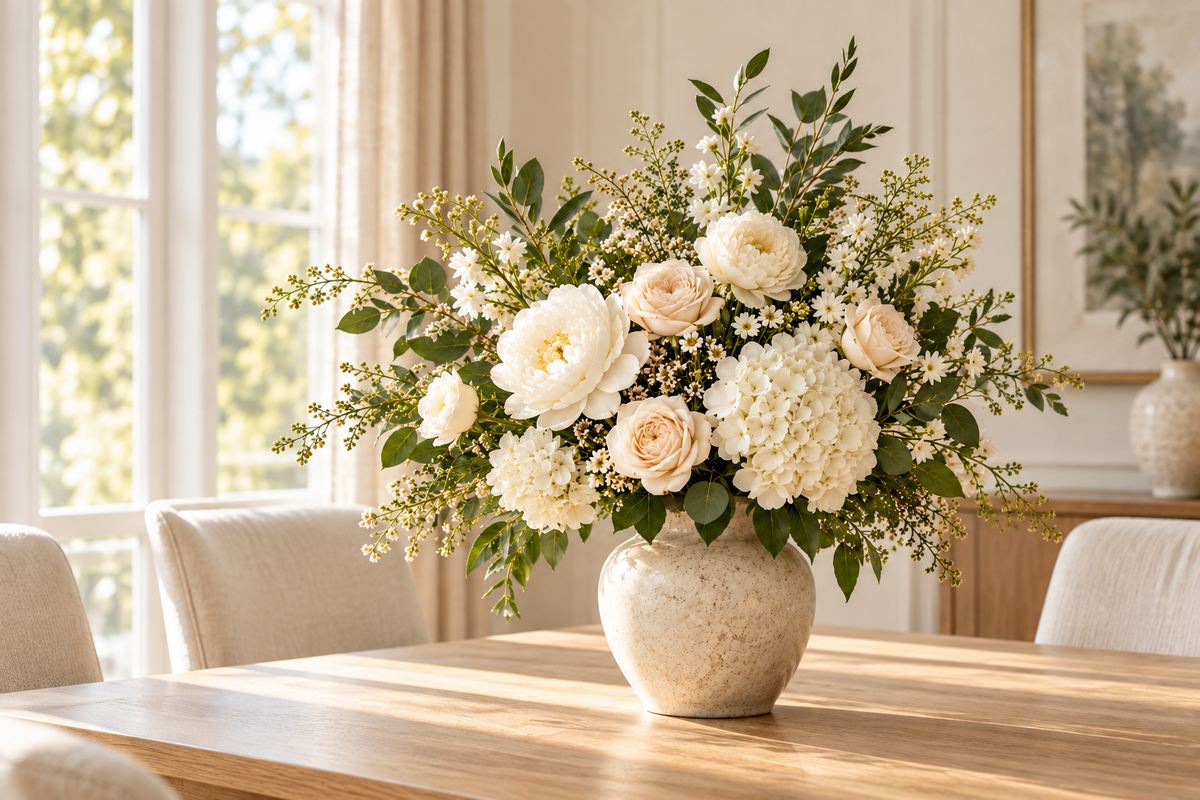
A natural-looking artificial flower arrangement begins with the space around it. Decide where the vase will live, how people will see it and how much room it can occupy. Then build a shape that suits that setting instead of trying to use every stem at once.
Choose the vase before arranging the flowers
Measure the opening as well as the height. A narrow mouth supports a small number of stems, while a wide opening lets them spread and may need more support. An opaque vase can hide the lower construction and makes it easier to adjust stem positions. Check that the base remains stable once the flowers are in place.
There is no single correct vase-to-flower ratio. Try the arrangement in its intended position and look at it from the doorway. It should feel proportionate to nearby furniture without blocking the objects or views you use.
Build the shape in five steps
- Set a direction. Use a few foliage or branching stems to establish the width and highest point.
- Add the main flowers. Place the largest blooms at varied heights rather than in a flat row.
- Connect the shapes. Add smaller flowers or foliage where the main blooms feel isolated.
- Leave breathing room. A little open space helps individual petals and stems remain visible.
- Check every useful angle. Rotate a table arrangement; check the front and sides of a display that sits against a wall.
If the stems are designed to bend, make gradual changes while supporting the stem. Test the height before cutting anything, and use a method appropriate to the construction. Some arrangements are supplied fixed or pre-styled and should not be dismantled.
Styling a dining table
Keep sightlines between seated guests open. A low, broad arrangement often works well, but check it with the table set: plates, glasses and serving dishes need space too. If you use candles, keep flowers well clear of the flame and heat.
Styling a console or entrance hall
A taller silhouette can work where the room has more vertical space. Leave clearance beneath artwork, lamps and shelves. If the vase stands near a walkway, avoid stems projecting where they will be brushed by people passing.
Choosing a colour palette
Begin with colours already present in the room. Ivory and white can provide a calm foundation; muted blush, green or blue can echo a cushion, artwork or textile. Repeat a small number of tones through the arrangement so the flowers read as one composition.
Hydrangeas give rounded volume, while peonies create layered focal blooms. Compare the open outline of The Wild with the generous focal point of The Hall. Use the size guide to plan your own space.
Finishing touches
Step back, remove anything that crowds the outline and make one small adjustment at a time. Keep the vase dry unless the specific product instructions say otherwise. Our care guide covers dusting and storage, and the full collection offers more palette and shape ideas.