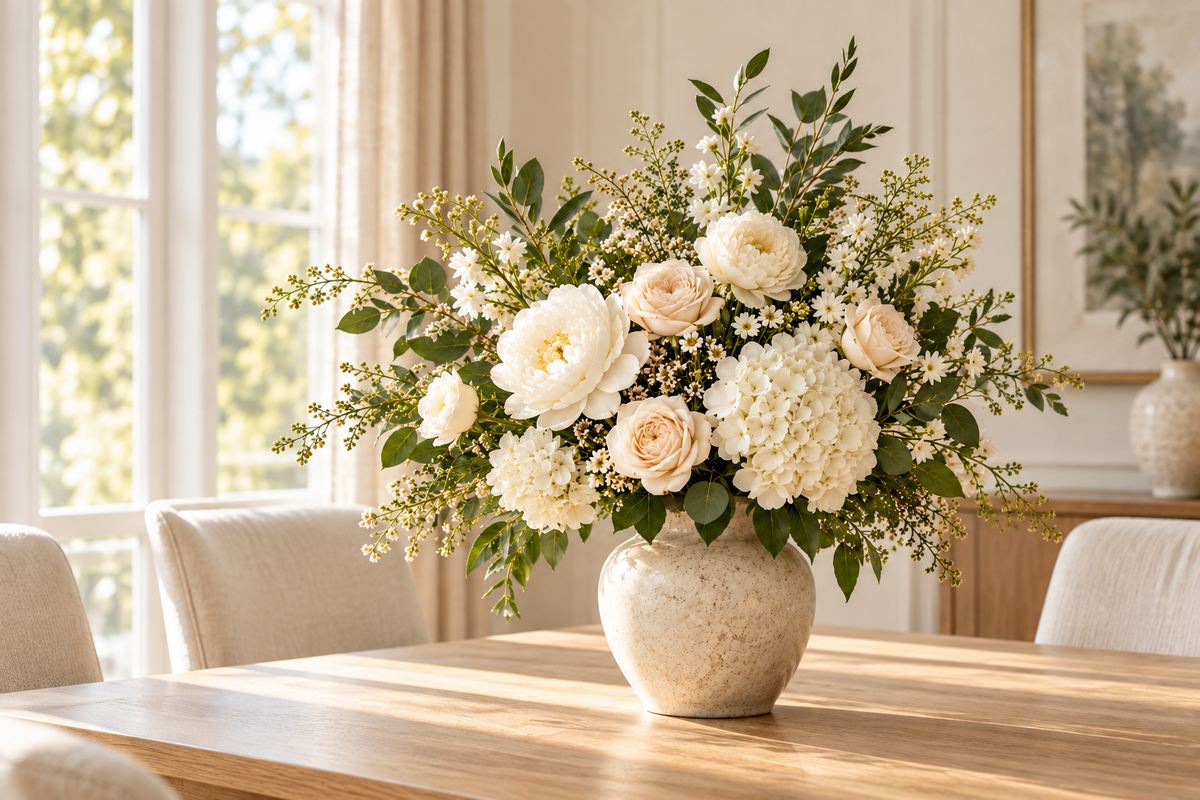
The right vase does more than hold artificial flowers. Its opening determines how the stems spread, its weight affects stability and its finish changes the mood of the whole arrangement. Choose the shape before choosing the colour.
Start with the vase opening
A narrow neck gathers stems into an upright shape. A broader mouth lets them lean outward and creates a lower, fuller display. If your flowers look cramped, a wider opening may help more than adding extra stems. If they fall flat around the rim, try a narrower neck or fewer heavy flower heads.
Keep the visible stem junction just inside the vase so that the arrangement feels connected to it. Avoid squeezing a dense bundle into a small opening: it can flatten petals and leave the upper half looking rigid.
Match the shape to the silhouette
| Vase shape | Styling use | Check first |
|---|---|---|
| Rounded with a narrower neck | Gathered roses, peonies and mixed arrangements. | The neck can hold the stems without crushing them. |
| Wide bowl or low vessel | Low table displays and rounded flower heads. | Loose stems have suitable support. |
| Tall cylinder | Upright stems and a more formal outline. | The base is stable enough for the height. |
| Generous urn | Branching greenery and statement flowers. | Its footprint and total display width fit the surface. |
Choose between opaque and clear
Opaque ceramic makes the lower stems less visible and is forgiving when their lengths differ. A matte, softly textured finish often sits comfortably with layered flowers and foliage. Glass gives a lighter effect but makes every stem and fixing visible, so the lower half needs the same care as the blooms.
Artificial flowers generally do not need water. Do not add it simply to make a glass vase look realistic: wire, paper wraps, coatings and adhesives may be affected. Follow the product’s care instructions. A deliberately dry, neatly arranged glass display is a better starting point than improvising with liquids or resin.
Test before cutting or fixing
Place the arrangement in the vase and assess it from normal viewing distance before shortening anything. If the stems are designed to bend, small supported adjustments can help. Do not force rigid sections or repeatedly bend the same point.
Only cut stems when the product instructions allow it and you are confident of the length. Wired stems need an appropriate tool; protect yourself from sharp ends. For a fixed arrangement, avoid pulling stems out of their base. See the size guide for proportion and the styling guide for building an outline.
Compare Everanthe arrangements or explore the complete flower library for buying, styling and care advice.