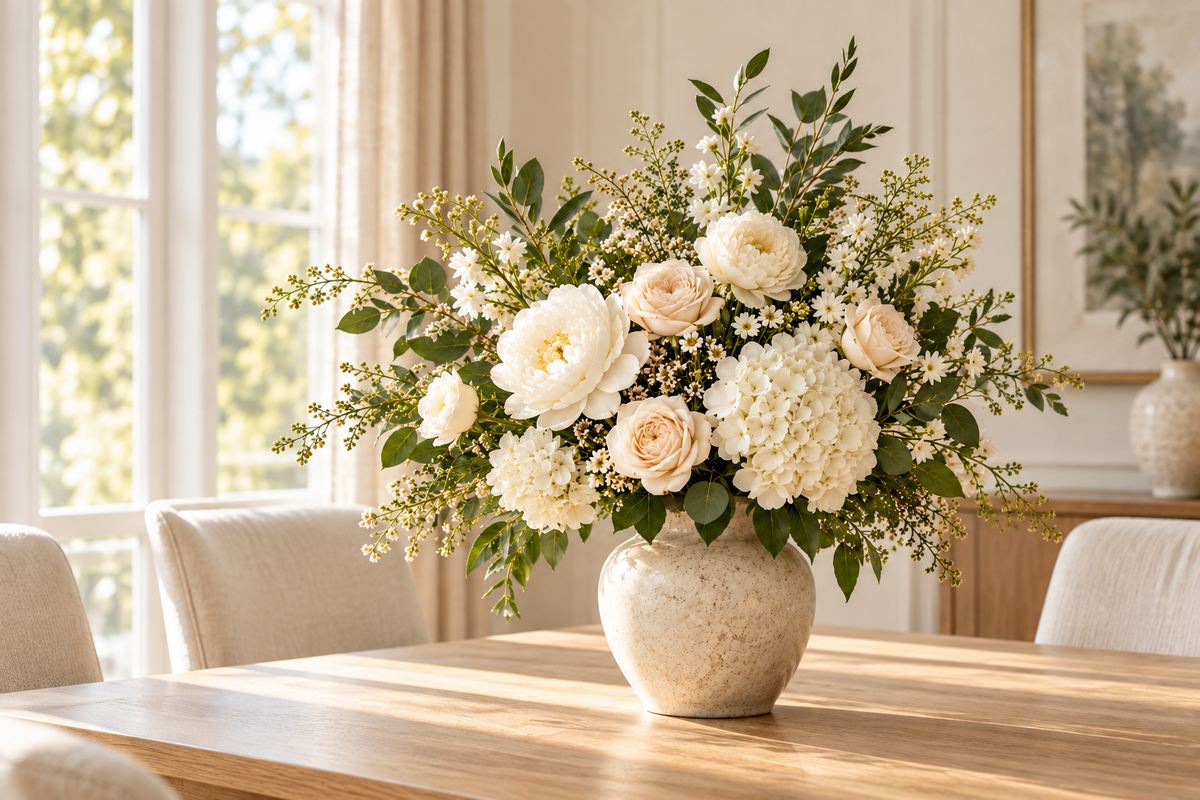
Fresh and artificial flowers offer different pleasures. Fresh flowers bring changing texture and, in some varieties, fragrance. Artificial flowers keep a chosen shape and colour in place without watering. The useful comparison is how each fits the way you live.
Compare the everyday experience
| Consideration | Fresh flowers | Artificial flowers |
|---|---|---|
| Appearance | Natural variation and a display that changes as flowers open. | A consistent design; realism depends on construction and styling. |
| Care | Water, vase cleaning and removal of spent flowers. | Dusting, careful positioning and material-specific cleaning. |
| Fragrance | Some flowers have a natural scent. | Usually chosen for appearance rather than natural fragrance. |
| Flexibility | Easy to change with each new bunch. | Can be moved, restyled or stored if the construction allows. |
| Cost pattern | Repeated purchases if you want a continuous display. | An upfront purchase, with care and eventual replacement to consider. |
Choose for the room and routine
A permanent display can suit an entrance hall, a guest room or a console where you want a consistent finishing touch. Fresh flowers may be especially enjoyable when you like choosing a new bunch, arranging it and watching it open.
You can use both in the same home. Keep a permanent arrangement in a regular position and bring fresh flowers into another room when you want a change. If combining stems in one vessel, follow the artificial stems’ care instructions: many are not suitable for standing in water.
Compare costs using your own habits
There is no universal saving. Someone who buys fresh flowers weekly has a different comparison from someone who buys a few bunches a year. Start with what you actually spend, how often you buy and whether a vase or delivery costs extra.
For example, £25 every two weeks totals £650 over 52 weeks. A £129 permanent arrangement has a lower initial purchase cost than that yearly routine, but only if it replaces those purchases for you. The calculator below lets you change all three inputs and makes its assumptions explicit.
Avoid broad environmental shortcuts
Neither category has one environmental footprint. Materials, production, transport, packaging, growing conditions, lifespan and disposal all matter. Reusing an artificial arrangement for longer changes the way you use it, but that alone does not prove it is environmentally better than every fresh-flower option.
Choose a display you expect to enjoy, look after it and be cautious about claims that are not supported by evidence. For practical next steps, compare artificial flower materials and read care guidance. You can explore the Everanthe collection by palette and silhouette.
Compare Everanthe arrangements or explore the complete flower library for buying, styling and care advice.