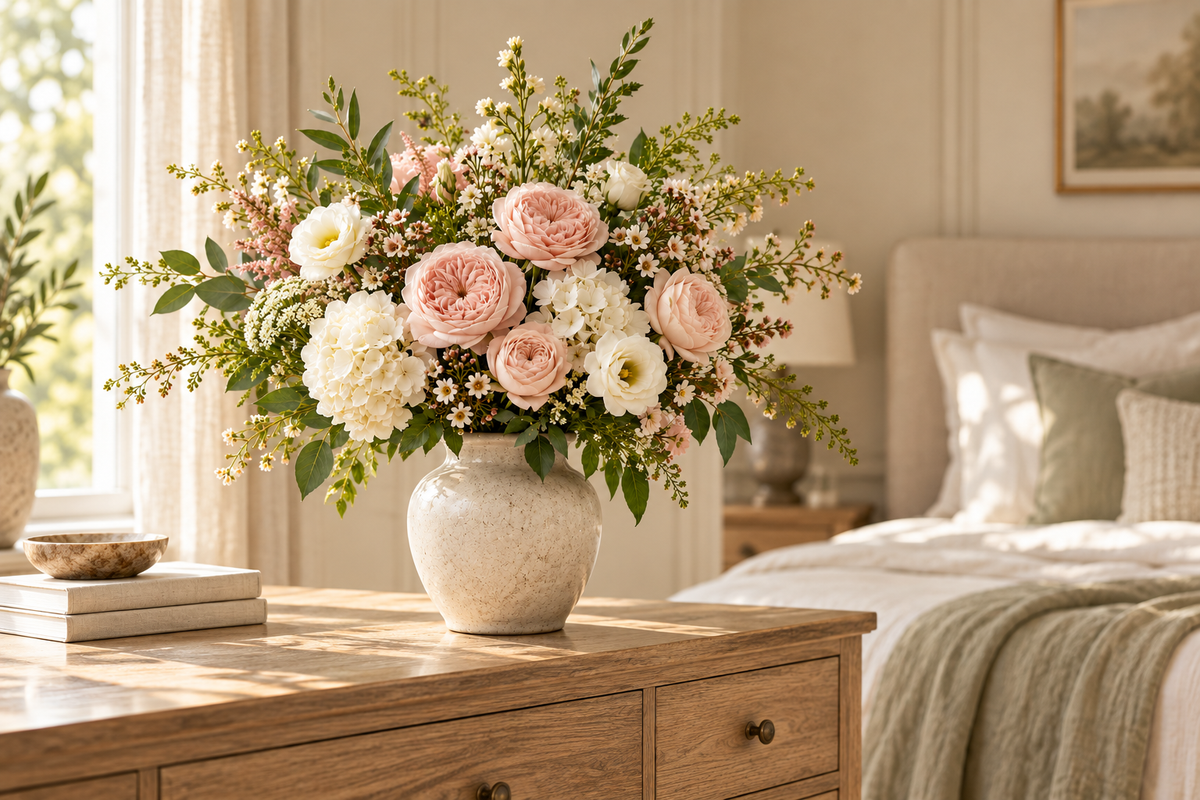
A convincing artificial rose is about more than a neatly formed flower head. Look for variation through the petals, a believable transition into the stem and a shape that works with the rest of your room. Roses can feel formal and gathered, or soft and garden inspired.
Choose the rose shape you want
A tight bud makes a quieter, more upright accent. A classic open rose has a clear spiral and a defined outline. Garden-style roses tend to have more layered, ruffled centres and a fuller shape. None is automatically better: the right choice depends on whether you want a disciplined bouquet or a relaxed arrangement.
In a mixed display, use rose heads as focal points and let smaller flowers or greenery break up the spaces between them. If every head faces forward at the same height, the arrangement can feel flat. A few modest changes of angle create depth without making the display messy.
Inspect petals, leaves and joins
- Check colour inside the bloom as well as at the edges. Small shifts can give depth.
- Look at petal edges for obvious fraying, thick seams or a repeated moulded shape.
- Check the flower-to-stem connection, particularly when the rose is viewed from the side.
- Inspect leaf surfaces and stems, not only the largest bloom.
- Use close-ups and wider views together: detail and proportion answer different questions.
The word “silk” is often used as a style description for artificial flowers and does not necessarily mean natural silk. Likewise, “real touch” does not tell you the complete material composition. Read the specification and our materials guide.
Build a palette around your room
Ivory roses bring warmth to creams, timber and stone. Soft pink can pick up the colour in a cushion or print without making the whole room pink. Bright white can look crisp, although it may read differently against warm walls and evening lighting.
Start with one main flower colour and a quieter supporting shade. Greenery provides a useful bridge between the two. A bowl or vase in a neutral finish lets the petals carry the colour; a strongly patterned vessel becomes part of the composition and needs more restraint elsewhere.
Style and care for your roses
Let the flowers breathe above the rim rather than compressing the heads into a solid dome. Dust delicate petals with a clean, soft brush and support each head as you work. Do not soak or spray a bloom unless its own instructions say this is suitable.
For a warm pink direction, explore The Blush. For a neutral arrangement with layered flower shapes, see The White. If you prefer a different focal flower, compare our peony guide and hydrangea guide.
Compare Everanthe arrangements or explore the complete flower library for buying, styling and care advice.